
The Edge Between

Have you ever had this experience? You are feeling stuck and frustrated.

You sit quietly, feeling your connection to the space around you and inside of you, sensing the earth energy flowing up through you, and how you are supported by your breathing, the space around you, and what you are sitting on. Now, bringing your awareness inside the body, you invite this whole thing of feeling stuck and frustrated to come forward.

Something comes forward. You feel something is tight somewhere in the body. You go to it. It wants to hide away, or go inward, or it is rolled in a tight knot, or something else. You say hello. You sense its inertia as it goes round and round in a circle. You sense it feels alone, lost or something else. You stay with it, opening to it. It lets you know that it has to dig down deep to protect something. You let it know you hear it.

Then something else comes forward, something or a place in you that wants to go out into the world. It wants action and acceptance out there. You say hello. You sense its bursting energy and anger. It lets you know it is not wanting to miss out on life. You let it know you hear it.

Now you sense that both are here. That place that feels lost and inward and that place that feels angry and wants a life in the world.  You hold both and sense the edge between them. You sense a stalemate there. It might feel as though one foot is on the gas and the other is on the brake. This is a rich place to be.  Have you ever spun a coin and noticed that as it spins, you can see both sides?

This is where you are now.  You are with both sides. This is the time to feel how your body is supported and how whatever comes is ok; that there is plenty of room for what is here. This is the moment to put lots of space around both and be curious!  The stalemate reflects their relationship with one other. Until each feels it is heard with deep listening, the stalemate will continue. Be patient. Sense if one or the other is wanting your attention more. If you don’t get an answer or you only sense the friction between them, turn to each one individually and let it know that you are here and you will give it your full attention. That there is plenty of time and space for both and you will give your full attention to each.

This is the time when your open and neutral attitude, your curiosity and interest, and deep listening is all important to your process. Acknowledge both. Take time with each one. Unraveling takes time.

Sometimes at this point in your process you may or may not be aware of a little hurt thing. If sensing a small one is here, acknowledge it letting it know you are with it. And, remain with the two sides of the coin listening deeply, allowing them to open and release their energy. Only then will the small thing be accessible to continue the process until it, too, unfolds with life forward energy.

Through this open and deep listening, what is right for you will emerge. You’ll feel its forward and bright energy. Go with it. This is your authentic self. Bon voyage.

The Stuff of Happiness

Look around. Do you have a lot of stuff? What kind of stuff do you have? Stuff that you use every day or frequently? Stuff that you use once in a while? Stuff that you never use?

Take a moment and write a list of the stuff you use every day, whatever it is.  You might walk room to room to make your inventory. Maybe your toothbrush, your favorite cooking pot, a pair of summer sandals, a ring, your bed and bed linens, a towel, a bike, a table and chair, a mobile phone. Just write down the stuff you use every day. You’ll probably be surprised that the list isn’t that long.

Now write down the stuff that you use frequently. Maybe you don’t use your bike every day, but you use it every other day, three times a week, or every weekend. Maybe something is seasonal. You use your skis every week during the snow season, but not in the other months. This stuff can go on the frequently used list.  You’ll find that this list isn’t that long either.

Now look around again. Everything else, all your other stuff, goes on the almost never or never use list. Don’t worry about writing all this stuff down. Just take some time, look around, reflect, and make a mental note of everything on this list.

If you find this task overwhelming, then start with just one room in your house or your clothes closet. Write down what you use every day and what you use frequently. The same rule applies. Your winter coat goes on the frequently used list because it is seasonal. If you have five winter coats and only wear one frequently then put one on the list. The other four are out.

Now, you might ask yourself why do I have this stuff?

You will probably say something like this, “I like my stuff.” That’s a start. Now, dig deeper. But why? Especially when you don’t use most of it? Not sure?

The answer is, in large part, because we humans are collectors by nature. Searching, collecting, and storing is in our genes. Pre-agricultural hunters and gatherers sought and collected food to keep alive during hard times, materials, like animal hides, to keep warm and protected in the cold, and other things, like grasses, to make storage baskets.  This necessity of collecting and storing kept our ancestors alive and safe during periods of difficulty and enabled them to pass down their genes to us, the future generations.

We still get a sense of security from having stuff. We feel deep within us that need to search out, collect, and store stuff to be safe. Look at all the stuff we own! We must feel safe, right? Maybe, maybe not. A car may give us a sense of safety because we know it can get us where we need to go: to work, to the hospital, to the food store. But if we can easily take the metro, the bus, or bike to work, hospital, and market, then the car is a nice to have, not a necessity.

The car may give us something more. Acquiring stuff can be the pathway to feeling accepted by a group. If the people over there all have ski jets or cars and I want to belong to their group, then I will be motivated to get a ski jet or car, too. With my jet ski or car I not only identify with but feel accepted by the group especially if my jet ski/car is comparable in features and brand to those owned by the members of the group. This sense of belonging and acceptance also gives us a sense of status, especially when we believe that others in the group already have a high status. The jet ski or car gives us status, too, at least for awhile until it doesn’t give us anything and we feel empty and unhappy again.

The search for stuff gives us pleasure. We seek bargains, special features and functions, or certain brands. Once we have found what we have been seeking, we feel satisfied and happy in the moment but it is not lasting.

So, what’s wrong? The acquisition of all this stuff only gives us a temporary sense of  belonging, and pleasure. We feel happy but it is fleeting. The old insecurities and anxieties come right back. There is a point when we have the stuff we really need and beyond that acquiring more stuff doesn’t give us anything but a momentary flash of pleasure. Then, wham, we feel anxious and depressed again.

What’s going on? Why does this happen? Think about it. Once our basic safety and security needs are met. The searching, collecting, and storing genes have done their work. But, our culture has told us. If you have more stuff you’ll be even safer, happier, and more accepted. Wrong.  Unless the stuff and how we use it aligns with our inner values, there is no lasting effect.

If we acquire the ski jet and use it regularly, improve our skills, share its fun with others, especially those who may not own a ski jet, and spend time having fun and laughing with others in a group who share our values, then it is worthwhile.  If we buy the ski jet, take it out a couple of times, and then leave it sitting in the garage, then it is not serving us. If we buy the jet ski and meet up with a group of other jet skiers who after a couple of encounters we realize don’t share our values, then the jet ski is not serving us.  Time to get rid of it.

When we are honest with ourselves, the amount of stuff that we need, like a cooking pot, and the amount of stuff that brings us together with others and helps us have fun, like, perhaps, a jet ski, are few. A few useful and fun things are all we need. This pile of stuff which we accumulate does not bring us happiness. Cooking a great meal in our favorite pot or riding our jet ski with our best friend does.

So if we really want to align with our authentic selves and feel happy, a good place to start is with our stuff. Getting rid of the stuff that does not serve us frees us to seek out the activities that align with whom we really are. This brings ongoing happiness and joy.

I’m so Tired.

I’m so tired. We’ve all said it. We’ve all felt it. Why are we all so tired? Is it that we are really physically fatiguing our bodies? Or is it that how we are spending our days? Perhaps our actions and thoughts are not aligned with our values–with our authentic selves.  If we are not feeling joy in what we do every day, all day, then we are out of sync with our authentic selves. Being out of balance in this way is exhausting.

Think about this. Ask yourself. What gives me joy? Right now, write down five things that give you joy. If you are finding that difficult, write down four things, or three things, or one thing that gives you joy. You may find that the things that give you joy are also difficult. For example, suppose you are a writer. Writing is difficult. It takes disciple and organization. It takes effort. It takes time. And, it gives tremendous joy. So, most often what gives us joy takes effort, organization, and commitment.

Now, put down your pen and close your eyes. Image you are immersed in doing the first thing (or only thing) on your list and ask, “Why am I doing this?”  The “why question” connects you with your authentic self.  When the answer comes from your core values, it feels right to be doing it and your body and mind will respond with a resounding ‘yes.’  This ‘yes’ is telling you that your values and actions are aligned with your authentic self.

This alignment is beautiful. This is where, if you put your energy and time, in ever widening circles, you will reside in joy.

If you don’t get a resounding ‘yes, this feels right,’ this is a signal that this action, this behavior may not be totally in alignment with your authentic self. Perhaps you are doing it because someone or something else feels it is right. Because they feel it is right you believe that it should feel right for you, too.  Now, that you’re picking up the covers you sense that there is something more for you to explore.

This is a rich place to be. Be curious. In this place you can sit and gently and compassionately ask inwardly, “What about this whole thing?” You’ll be surprised how your body will respond, how it will show and tell you all about how this activity aligns or not with what feels right to you.  It will show you where your motivation is coming from, perhaps from the obligation or pressure coming from family, friends, work, society, or culture. This exploration takes time and a willingness to be gentle and compassionate with yourself. It typically does not express itself like a bolt of lightening. Be patient. It will unwind and open and show you where your true alignment lies.

The Hyper Self-Critic

Oh, those nagging, hyper-critical voices in our heads! They make us feel so bad.

Sometimes there is just one voice; sometimes many. They go round and round, repeating themselves over and over. They have a rhythm, ebbing and flowing and then rising in a crescendo. When they are in the background, we hardly notice them or ignore them, and then something turns up the volume and they consume our attention and energy.

Their themes are consistent, too. “You are not good enough,” “You are bad,” “You should be ashamed,”  “You are wrong,” to “You are not worthy,” “You are broken,” “You are selfish,” and so on.

These voices  and their messages are not happy or helpful. They derail us from our work and enjoyment of life. They shut us off from our friends and family. They make us feel small, judged, and useless.

We try to shut them off, bury them forever, and hope to never hear them again. We push and push. The more we push, the more insistent they become.  Finally, exhausted from pushing, we succumb. We believe them.

For a moment, consider this. They are very alive. They come from a part of us that got stuck in a moment when we were unable to discern how to respond in wholeness. Often we were children, little children. It is that little child in us who got stuck in that moment of criticism or trauma. And, sometimes, they stem from events in our adulthood.

This happened to me. After an ectopic pregnancy that hemorrhaged and many subsequent and unsuccessful attempts to become pregnant again, I was depressed, defeated, broken, and vulnerable. On a visit to see my mother, she said,” The only reason you are not getting pregnant is that you are too selfish.”  This judgement struck me like a bullet in my gut. My whole body froze in that moment. The wound was deep and lasting. And there it was, that voice in my head repeating, “You’re too selfish.”  It took me a long time, deep investigation, and much suffering to learn how to release this hyper-critical, damning voice and move forward in my life.  This is how to go forward.

Start here. Try this with patient and gentle goodwill for yourself.

Find a quiet place. Your office with the door closed. A bench in a quiet corner of the park. Your bedroom. Or, some place else.

Sitting quietly, bring your attention inside. You might have your eyes closed. This usually helps you to be at home inside your body. If the voice(s) is not active in the moment, graciously invite it to come forward. You might say something like, “I’m inviting that whole thing about feeling judged selfish… or whatever it is to come forward.”

Gently, say “Hello, I see you are there,” in a cordial and neutral kind of way. Perhaps in a similar way to how you might say, “hello” to a stranger passing you on the street.

Pause for a moment too, putting your full and gentle attention right there. You might feel a little space open. Be patient. Let your breathing relax.

Be curious and interested, but not overly eager. This voice has something to say and show you and needs space to unfold and share with you.

Notice your bodily sensations and their texture and quality. You might sense tightness,orals, rose colors, or hear something being said, or an image might emerge.

Sit with it for awhile and listen. No rush. There’s plenty of time. No judgement. There’s not good or bad, right or wrong.

Other thoughts and sensations may come up. Go with whatever is wanting your attention right now. The process is like peeling the layers of an onion. All unwinds given space and time.

Keep listening openly. And when you hear something, see something, or feel something, acknowledge it. You can say to yourself, “I’m sensing something in me that …” and as it shows itself more you can acknowledge by saying “It’s letting me know …”

If it feels right, find a guide who can support you and your process.

The unwinding happens at its pace, and you will notice little steps, small openings, and energy release like a breath of fresh air. This is your healing unfolding.


What the Other Guy Should be Doing

My spiritual teacher, Adyashanti, told us a story last week to illustrate a profound “aha” about what it means to live authentically, to let go of the ego mind and all its ‘shoulds,’ and live from our true authenticate selves.

Here’s the story.

When he was a young man in his twenties he worked in a bike repair shop. It was a busy place and everyone scrambled to get all the work done that had to be done that day. The repair manager didn’t pitch in and help. He sat at his bench with his tools in front of him and read magazines. When asked why he didn’t help, he would say, that he was not paid to do anything; that his job was to make sure that they did what they were supposed to do.

This attitude didn’t sit well with my teacher. He suffered watching this able-bodied manager sitting there doing nothing but reading magazines while everyone else raced around to get the day’s work done. It really upset him. The more he thought about it, the more it upset him. This went on for some time.

Then, one day my teacher had an ‘aha.’ It came to him that he was upsetting himself because he had an idea of what his manager was supposed to be doing and the manager was not conforming to it. This idea of what should be happening was making him upset. Then he just let go.

He let go of his judgments about his manager. And, he let go of the endless mental activity around what he thought the manager should be doing.

By dropping into the now, my teacher understood that the manager was just the way he was and wasn’t causing him any difficulty. In seeing this, he understood the truth and let go of the thoughts and ideas about his manager. From that day on he was free and happy.

This is true freedom. The freedom that comes from waking up from being identified with our thoughts and ideas about what should be, what should happen, and how others should behave, think, or believe. Once we let go of all the ‘shoulds’ we are free to live truly authentic lives.

So each time, I catch myself saying, “should” I pause. Ah, that little ego-word is here I say gently to myself. Then I let it drop away as a leaf drops from the tree and I am happy.


What’s Hurting?

When you sit quietly and comfortably and bring your awareness inside, what greets you? Do you feel open and intimate? Do you feel that you can sit down with whatever is there like you would sit with a friend or stranger beside a campfire? Or, perhaps you feel something else.

Something doesn’t want your presence. Something is angry and rebellious. Something disappears into blankness. Something says, “Go away. I don’t want you here.” Or, says, “You’re ridiculous. ” Or lets you know that you can’t do it, that you are a failure.

What to do? Really be there for it. It can be the ugliest, most violent, most condescending thing you have ever encountered.

Really feel whatever it is in your body.  Invite your body to show you/tell you something about what’s here with you right now. Invite your body to open to what you are feeling.

What you are feeling is resistance. Experience your resistance. It may feel uncomfortable. It will feel uncomfortable. Start with inviting your grounded, open presence, your whole self to be here right now. And, know that you cannot fail at having whatever experience you are having. Have your experience! Be open to it. Invite it to be here right now.

Know that what is hurting is not your resistance, it’s your relationship to it that hurts. Say, my intention, my energy is here right now to experience what is wanting my attention right now. No holds barred. I welcome this resistance and my experience of it to be here with me now.


We Are Like Sprouting Potatoes

To live, to produce more potatoes, the potato’s inner nature, its wiring, says sprout when conditions are sufficient. So when there is the darkness of a cellar or of the earth, potatoes sprout. In this way we are just like sprouting potatoes in the dark. We, too, have an inner knowing to live our lives forward when conditions are sufficient. This forward growth direction is a characteristic of life’s process.

IMG_5295

Life is process. We may feel like solid things, buffeted by situations and our environment, but we are not. We are process interacting with our environment. Consider the breath that keeps us alive. The breath is interaction with the air around us. We are not separate from our breath. We breathe and it feels right. The potato is not separate from the darkness—the darkness is intrinsic to how the potato lives forward giving us new potatoes. So, too, we are not separate from our situations and environment.

So how is it that we experience stoppages? That we feel stuck? That we are unable to live the lives we feel are right for us? When young and growing, we may not have the inner capabilities to live forward through a situation. The mother that ignores us. The parents that criticize us. The war that surrounds us. The illness that takes our loved ones away from us.  The people who are cruel to us. These are the kinds of things that can cause our inner process of living forward to stop, to get stuck.  As we grow older other situations may occur creating a stoppage or reinforce one from our youth. We may experience separation from loved ones, illness, or the harmful effects of a bad economy. Perhaps criticized as a child, as an adult, we feel inadequate and struggle to move forward in our chosen career. Or something else.

And when there is a stoppage, when something in us doesn’t live forward but remains stuck in some place in us, in our tissues, in energy channels, in our very being, then we feel that something is not right. Something may not be happening that we want to happen. We may feel our thoughts and emotions circling like wagons against attack. Something in us may rebel or capitulate. These are all signals that there is something that has not been able to process. Something in us lacked the resources and support to move through a situation and now we feel stuck.

But it doesn’t have to be that way. By coming into presence, feeling our wholeness of body, feeling how we are supported, by bringing gentle and curious awareness to that something that doesn’t feel right we begin our healing. It will emerge and come forward as something in our body that at first may not have words to describe it and yet by acknowledging it and bringing our gentle and loving presence to it, little by little it will show itself. And, by staying with it listening and reaffirming, we allow it to release its stuck energy and move forward with  a sense of rightness in life, just as the potato sprouts in the dark.


I’m Confused

“I’m so confused,” you might say to someone else. “Something in me is so confused,” you might say inwardly to self. So what about this confusion?

The dictionary defines confusion as a lack of understanding; uncertainty, or as the state of being bewildered or unclear about something in one’s own mind. When I am feeling confused, there is a lack of clarity. Murkiness abounds. And that feeling state of bewilderment and perplexity is there too.

It might also feel very dense, all tied up, or turbulent as though it is impossible to unravel the threads to gain understanding. It can be difficult to navigate confusion. What to do? Bring your presence, neutral space and time and empathetic listening.

Give yourself a moment to center, perhaps take a breath letting the exhalation last a little longer than the inhalation. Then say to it, “Hello, I see you are there,” with interest and curiosity. Take a moment and sense how it reacts.

If your “hello” engages it in a neutral but friendly way, take some time to describe it. How it feels, its texture or quality, or its shape. It may show you or tell you something.

If, on the other hand, it feels tense and tight as though there is not much or no space or air, back off a bit. Take another breath and bring your awareness to the ground your feet are touching and how that supports you. Sense your hands. Fingers, palms, and back of hands. Now as you take another breath allow your awareness to follow its journey through the nostrils, down the throat, into the chest and even further down to stomach and belly. Notice how it feels to arrive there.

Now, say inwardly, “I am the space big enough for whatever needs my attention. Sense the space. Back off a bit more, if needed. Sense the space again. Sense and see if something that is feeling confused is still there. Good, It is. Say “hello” gently or if that feels like too much. Just inwardly acknowledge its presence like you might inwardly acknowledge the presence of someone you don’t know who sits down next to you on a bus, train, or plane. Now, giving it lots of space, take some time to describe it. How it feels, its texture or quality, or its shape. It may show you or tell you something.

As you take your time and give it space, the feeling of confusion may change. You may notice that it is not one thing but maybe two or more things. Each thing that arises has its point of view and is wanting your attention. It wants to be listened to gently, deeply and without judgment.

Sometimes, when we sit down and keep this feeling of confusion company, we are struck by a sense of the unknown. This sense of not knowing can feel scary. That’s ok. We can reflect back to it what we sense, saying inwardly to this something, “I’m sensing you are not knowing and I sense you feel scared.” This kind of active and open listening is exactly what it is wanting.

Often, when working with a sense of confusion, two or more things arise. We may sense that they are engaging in some kind of dialogue, sniping, or acting out a tug-of-war. This kind of back-and-forth is wanting the wisdom of our presence to step in and say respectfully to each one. “I am here with you and will listen to you. You will have your turn.” Once you ave given this inner invitation to each hold all of them in the space and sense which one is needing your attention more right now. This way each part will have time and space to be with your full and open self so that it can be heard. Once heard in all its intricacies, its forward energy will release and confusion will transform into an appropriate action or understanding.

When we engage these practices of open and focused presence, of giving our attention, and listening deeply without judgment, confusion transforms. It shows us something from which clarity opens to us.

“This Cup Is Already Broken”

“This cup is already broken” writes Jack Kornfield remembering the words of Ajahn Chah who holding up a beautiful china cup used the image to teach that we cannot control, that we cannot be certain of any outcome, that we live with uncertainty. [https://jackkornfield.com/the-wisdom-of-insecurity/]

Uncertainty is a big concept. Most of us spend much time and energy trying to negate it and control the outcomes of our projects and careers, our children, our spouses, our friends, our own lives. “If only this. If only that,” we lament. We suffer as we watch, in spite of our best efforts, loved ones fall ill, our children fall on hard times, our projects or careers that we have poured our hearts and money into fall to pieces.

Planting my first cherry trees in my orchard last week, I was full of what-ifs. I worried that the clay soil would impede their survival, that the deer would jump the fence and nibble away their fragile leaves, or that disease would attack before the they were established enough to combat it. And, then I just let go. Taking a deep breath and allowing my exhalation to fully express itself, I surveyed my work knowing that I had done my best. I had bought hearty trees, planted to instructions, and fenced them in as recommended. I will continue to tend to them and when something goes wrong, as it surely will, I’ll deal with it.

Uncertainty, it turns out, is at the very quick of life. In particle physics the uncertainty principle “tells us that there is a fuzziness in nature,” writes Alok Jha [What Is Heisenberg’s Uncertainty Principle, Guardian.com, 10 November 2013]. This principle says the more we are certain of the position of a particle, the less certain we can be of its momentum and vice versa. We cannot be certain of both at the same time.

Uncertainty is the stuff of life. We strive so hard to know both the position and momentum of every particle of our lives, to no avail. Just when we think we have control, the universe intervenes and fuzziness breaks loose. Fuzziness is our aliveness. When we focus on the outcome and things fall apart or go wrong, we suffer. So why do we keep trying?

At the heart of our desire to control is our need for safety.

To feel safe, we can shift our perspective. Rather than focus on outcome, focus on process. When we deal with what comes in measured and thoughtful ways, when we make reasonable plans and act on them, when we focus on what is in the moment, what is here right now, our endless worry subsides. The churning go-round of “what ifs” dissipates and in its place a calm and curious energy arises allowing us to respond creatively and meaningfully.

This change in perspective allows us enormous freedom. No longer tied to an outcome we cannot control, we are free to find ways to enrich our experience and relieve suffering in the moment, no matter what comes. We cannot make our runaway daughter come home, but we can find services and professionals to assist her. We cannot make our friend’s cancer go away, but we can find health resources for her and make our time with her caring and supportive.  Living on a flood plain, we cannot stop the flood that ravishes our home but we can prepare  with sandbags, insurance, and stocks of necessary provisions. It is our plans and actions and our ability to shift these without holding on that provides safety. Paradoxically it is in our letting go that we find safety and freedom.


How About It? Learn Focusing

I don’t often write about events or activities in my blog, but today I want to share some wonderful news. Perhaps you’re a reader of my blog and have wanted to dive deeper into Focusing but didn’t know how or didn’t feel you had the time. Here’s an opportunity to learn Focusing as well as investigate other topics like Thinking at The Edge.

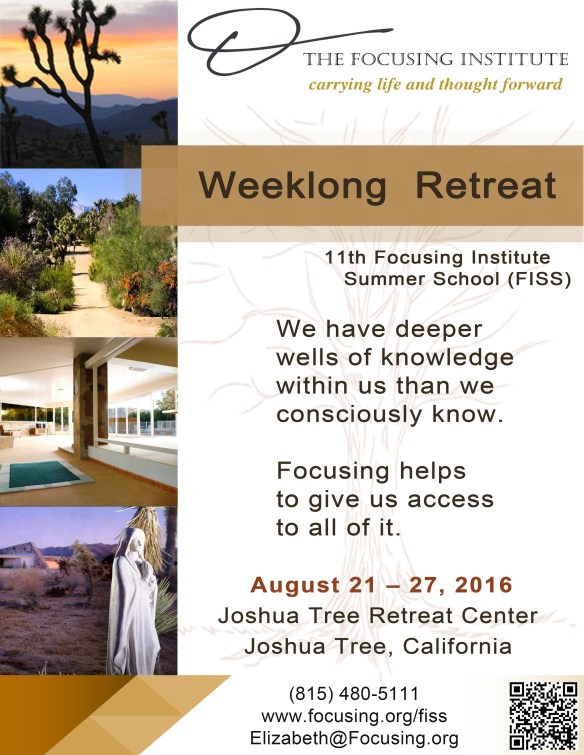
The Focusing Institute, our professional organization, holds an annual summer school. This year it is being held from August 21 – 27, 2016 on the west coast at the Joshua Tree Retreat Center in Joshua Tree, California.

Why learn Focusing at the Summer School? Perhaps you’re needing time and space away from your daily routine or have vacation coming. Or maybe you prefer in-person learning and never seem to have the time for a once-a-week or weekend class when you are immersed in work and family. Perhaps you are wanting to learn in the safety of a supportive and accepting community of like-minded people.  Whatever your reasons, learning Focusing and experiencing how it can be applied in the arts, in deep thinking, and in work with children is what you’ll have the opportunity to do at Joshua Tree. Click here for more information and to register.

FISS Poster 2web